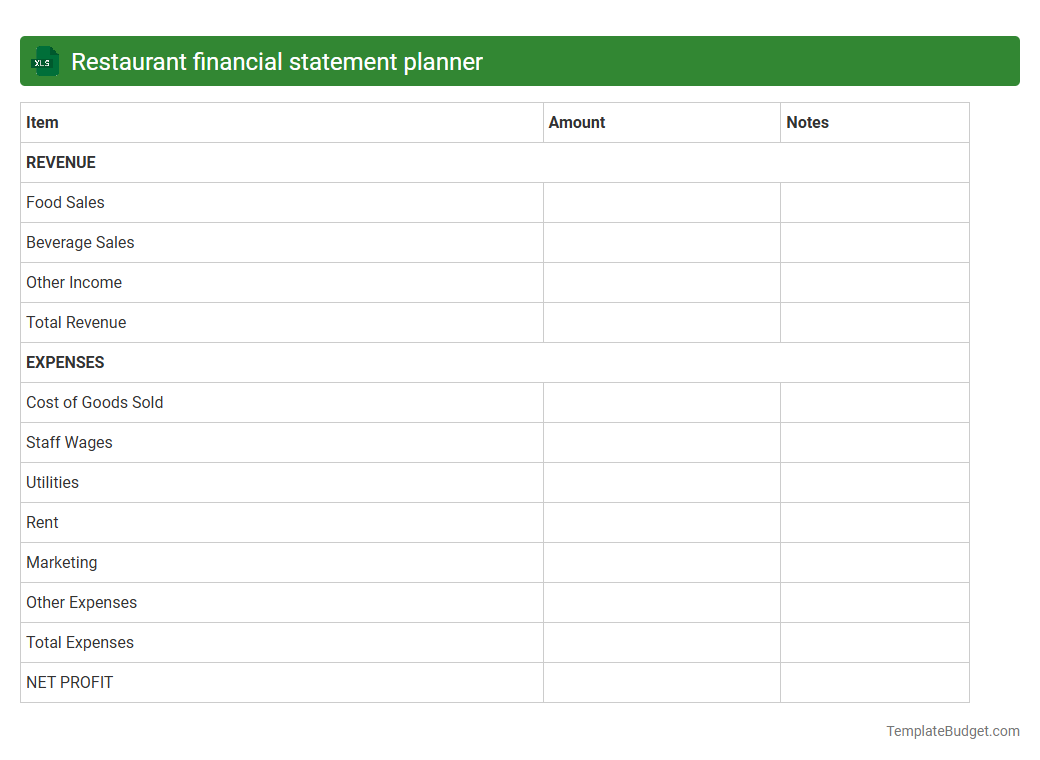
Effective restaurant financial planning is essential for managing costs, maximizing profits, and ensuring long-term business success. A comprehensive financial planner helps restaurateurs track expenses, forecast revenue, and optimize cash flow to make informed decisions. Explore the Excel template below to streamline your restaurant's financial management and achieve greater control over your business finances.
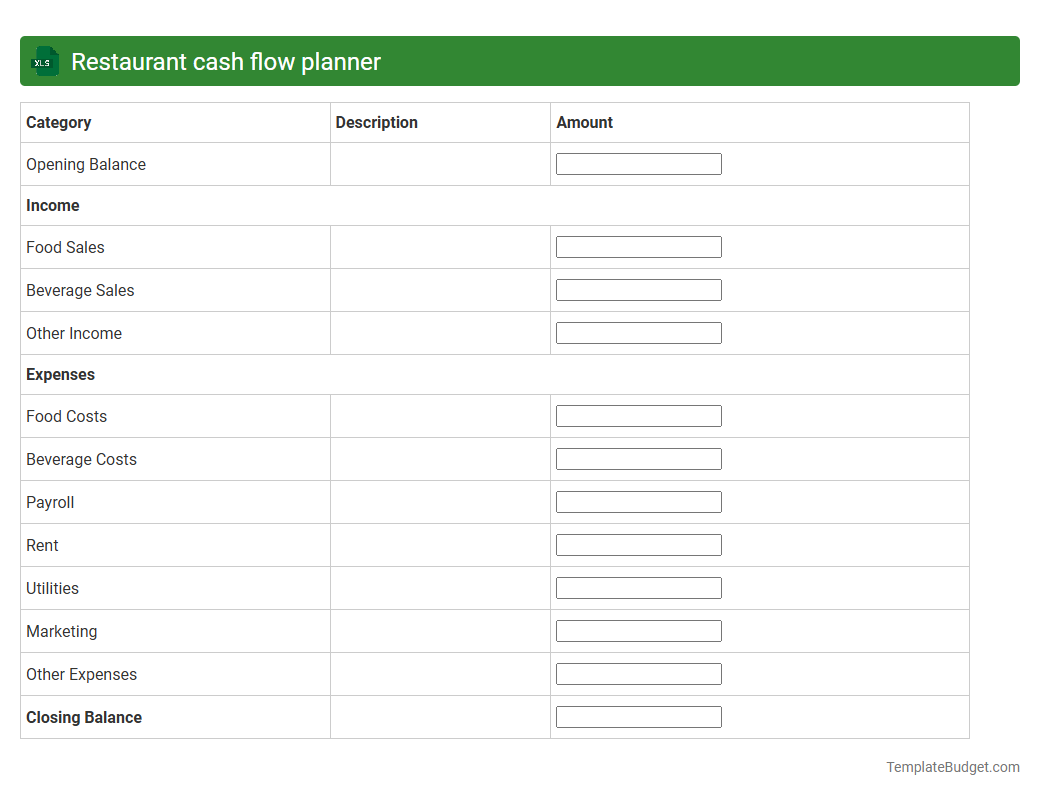
Restaurant cash flow planner
An Excel document for a Restaurant Cash Flow Planner typically includes detailed worksheets for tracking daily sales, expenses, and payroll costs. It features customizable categories such as food and beverage inventory, utility bills, and supplier payments to provide accurate cash flow projections. Financial tables and charts help visualize income streams and cash outflows, enabling restaurant owners to manage budgets effectively and plan for seasonal fluctuations.
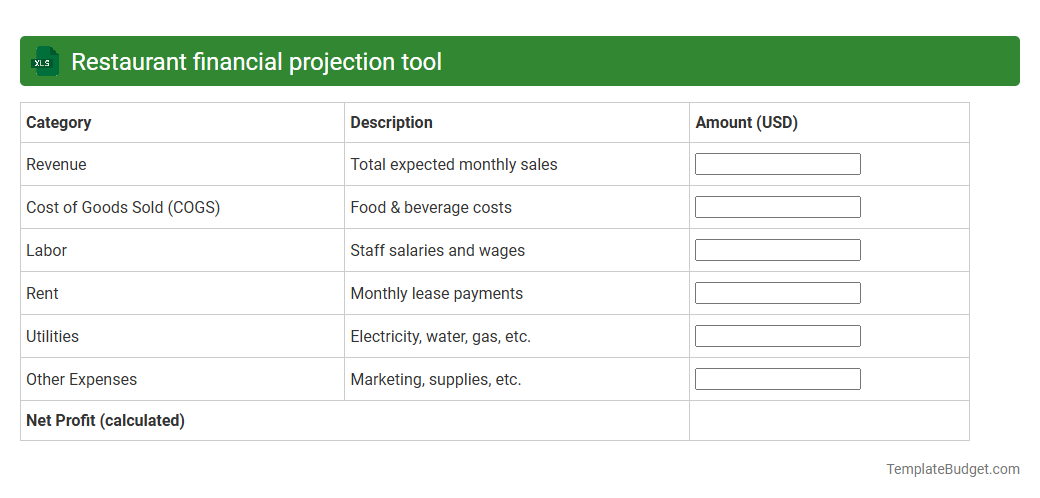
Restaurant financial projection tool
An Excel document labeled "Restaurant Financial Projection Tool" typically contains detailed worksheets including sales forecasts, cost of goods sold (COGS) analysis, labor expense breakdowns, and operating expense categories. It often features dynamic financial models with embedded formulas to project monthly and annual revenue, profit margins, cash flow statements, and break-even analysis tailored to restaurant operations. Key inputs might include menu item pricing, customer footfall estimates, and seasonality factors to enable accurate budgeting and strategic financial planning.
Restaurant profit and loss planner
An Excel document titled "Restaurant Profit and Loss Planner" typically includes detailed financial data such as revenue streams from food and beverage sales, operating expenses like labor costs, rent, and utilities, as well as inventory and supply costs. It often features categorized expense and income tracking, profit margins, cash flow projections, and charts or graphs for visual financial analysis. This planner assists restaurant managers in budgeting, forecasting, and optimizing profitability by providing transparent, real-time financial insights.
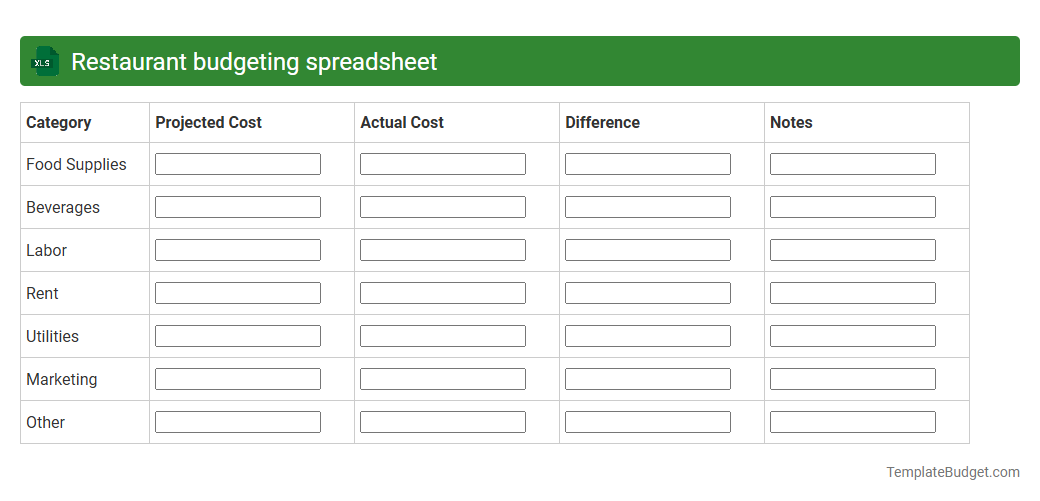
Restaurant budgeting spreadsheet
A restaurant budgeting spreadsheet typically contains detailed sections for tracking expenses such as food and beverage costs, labor wages, and overhead expenses including rent and utilities. It includes revenue projections, daily sales records, and cost of goods sold (COGS) calculations to monitor profitability. Formulas for variance analysis, cash flow forecasting, and inventory management are common features to aid in financial planning and operational efficiency.
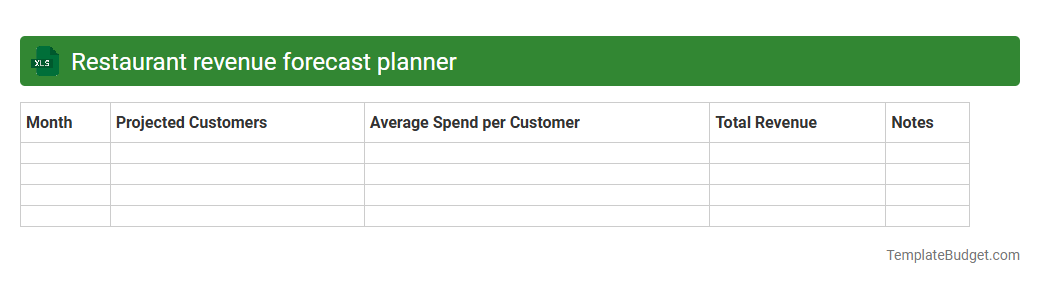
Restaurant revenue forecast planner
An Excel document titled "Restaurant Revenue Forecast Planner" typically contains detailed financial projections including monthly and annual sales revenue, cost of goods sold, labor expenses, and operating costs. It often features interactive charts, pivot tables, and scenario analysis tools to help restaurant owners predict cash flow, analyze profit margins, and plan for seasonal fluctuations. Key metrics such as average check size, customer footfall, and menu item profitability are usually tracked to support data-driven decision-making.
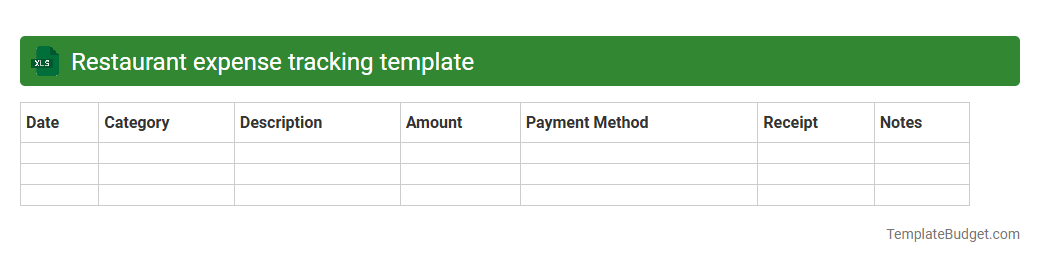
Restaurant expense tracking template
An Excel document for a restaurant expense tracking template typically includes categorized expense fields such as food costs, labor wages, utilities, and equipment maintenance. It contains columns for dates, vendors, payment methods, and amounts, enabling precise financial monitoring and budgeting. Formulas and summary tables are often integrated to calculate totals, generate monthly reports, and analyze spending patterns.
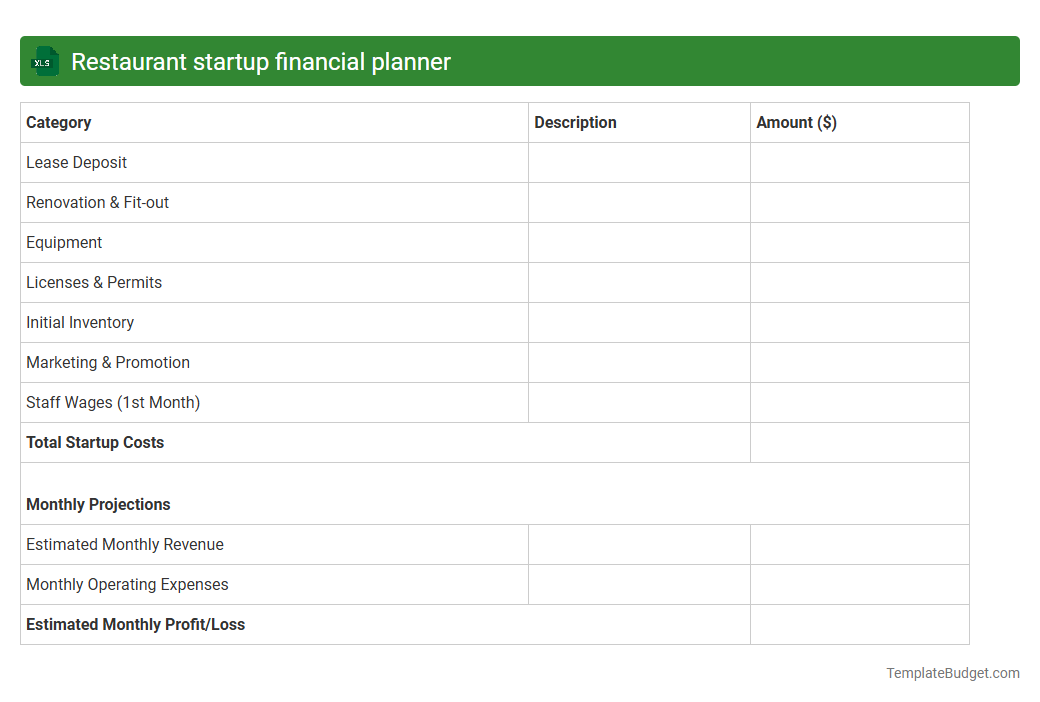
Restaurant startup financial planner
An Excel document for a Restaurant Startup Financial Planner typically includes detailed worksheets for startup costs, projected income statements, cash flow analysis, and balance sheets. It often contains sections for initial capital investment, monthly revenue forecasts based on seating capacity and average ticket size, and expense categories such as labor, food costs, rent, and utilities. These financial components help entrepreneurs model profitability timelines, break-even points, and funding requirements efficiently.
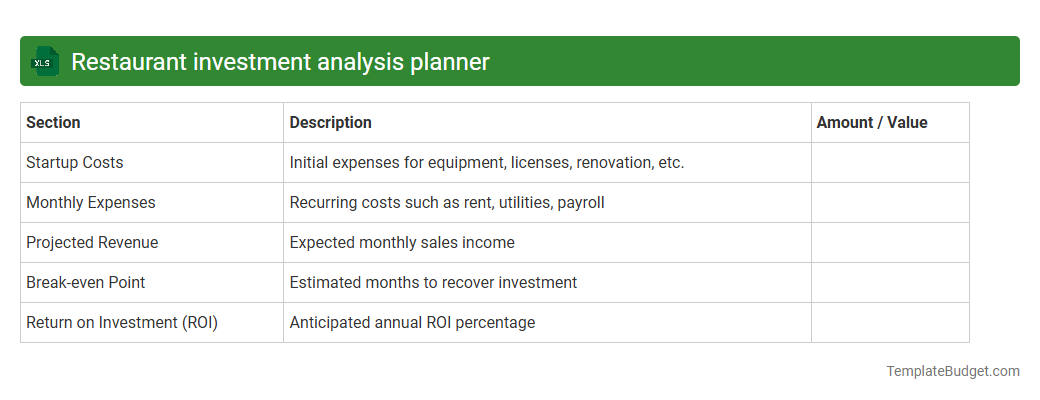
Restaurant investment analysis planner
An Excel document labeled "Restaurant Investment Analysis Planner" typically contains detailed financial models such as projected revenue, cost breakdowns, and profitability forecasts. It includes key metrics like return on investment (ROI), break-even analysis, and cash flow statements to support informed decision-making. Commonly featured are customizable input fields for variables such as startup costs, operating expenses, and market growth rates, enabling dynamic scenario planning.
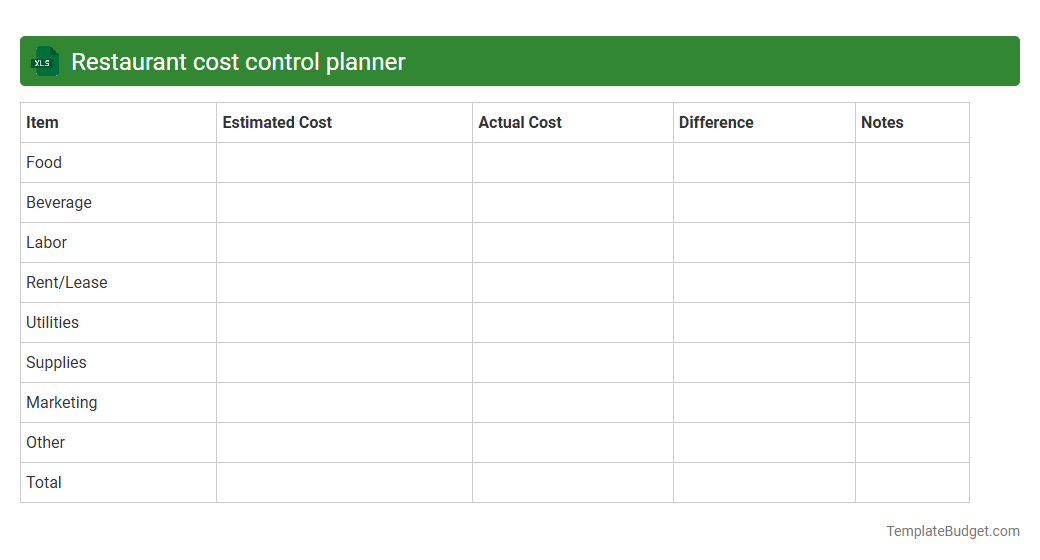
Restaurant cost control planner
An Excel document titled "Restaurant Cost Control Planner" typically includes detailed spreadsheets for tracking inventory levels, food and beverage costs, and supplier pricing. It features cost analysis tables, budget forecasts, and sales data to monitor profit margins and reduce waste. Essential components also involve labor cost tracking and variance reports to optimize overall operational efficiency.
Restaurant financial statement planner
An Excel document for a restaurant financial statement planner typically includes detailed sections for revenue tracking, such as daily sales and categorization by food and beverage services. It incorporates expense logs covering payroll, inventory costs, rent, utilities, and marketing expenses, enabling precise budgeting and cash flow analysis. Key financial metrics like gross profit margin, net profit, and break-even point are calculated to assist in strategic decision-making and financial forecasting.
Understanding the Role of a Restaurant Financial Planner
A restaurant financial planner helps manage the financial health of the business by analyzing expenses, revenues, and profit margins. They provide strategic insights to optimize budgeting and ensure sustainable growth. Their role is crucial for aligning financial goals with operational performance.
Key Financial Challenges Faced by Restaurants
Restaurants often face challenges such as fluctuating food costs, labor expenses, and unpredictable customer demand. Managing cash flow and maintaining profitability amid competition can be difficult. Effective solutions require careful planning and adaptive strategies.
Essential Skills for Restaurant Financial Planning
Successful financial planners in restaurants need strong analytical skills, budgeting expertise, and an understanding of industry-specific cost variables. Proficiency in data interpretation and financial reporting is also vital. These skills enable informed decisions that enhance financial performance.
Setting Up an Effective Restaurant Budget
Creating a budget involves forecasting revenues, estimating costs, and setting financial targets for different departments. A well-structured budget assists in monitoring expenses and achieving profitability goals. Regular reviews ensure the budget remains aligned with operational realities.
Cash Flow Management Strategies for Restaurants
Maintaining consistent cash flow requires tracking daily transactions, anticipating expenses, and managing payment cycles effectively. Strategies include optimizing inventory turnover and negotiating with suppliers. Strong cash flow management prevents liquidity issues and supports smooth operations.
Cost Control Techniques for Culinary Operations
Effective cost control involves monitoring food waste, managing portion sizes, and negotiating supplier contracts. Implementing inventory systems and tracking labor costs help reduce unnecessary expenses. Controlling costs directly improves the restaurant's profitability.
Analyzing Profit Margins and Break-Even Points
Understanding profit margins and break-even points enables restaurateurs to price menu items appropriately. This analysis helps identify which products generate the most profit and where costs can be trimmed. Accurate calculations are essential for financial sustainability.
Leveraging Technology in Restaurant Financial Planning
Technology tools like POS systems, accounting software, and analytics platforms streamline financial tracking and reporting. Using digital solutions enhances accuracy and saves time in managing finances. Technology also provides real-time insights for quicker decision-making.
Financial Forecasting and Growth Planning
Forecasting involves projecting future revenues, expenses, and cash flows based on past data and market trends. Growth planning uses these forecasts to set realistic expansion goals and investment strategies. This proactive approach ensures the long-term success of the restaurant.
Choosing the Right Financial Planner for Your Restaurant
Select a financial planner with experience in the restaurant industry and a track record of improving profitability. Look for skills in budgeting, cash flow management, and strategic planning. The right planner becomes a valuable partner in achieving your restaurant's financial objectives.
More Restaurant Excel Templates